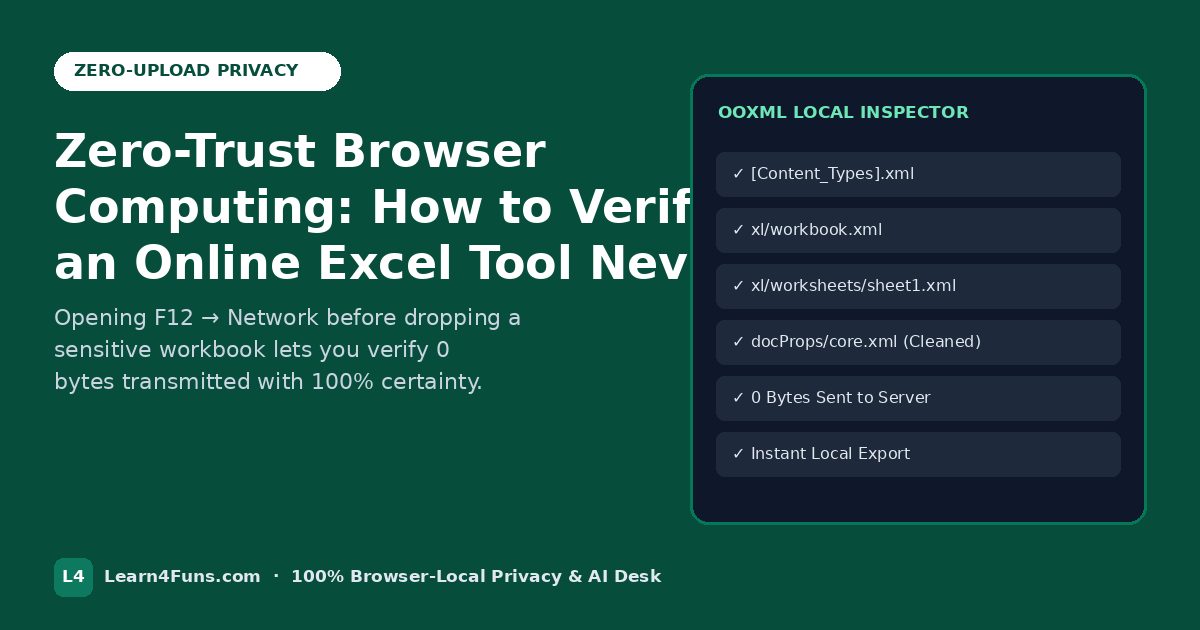
A 30-second DevTools Network-tab check anyone can run to prove whether a web tool processes files locally or on a remote server. In this practical Learn4Funs guide, we break down the exact workflow, formulas, and verification steps so you can execute reliably on any computer or phone.
Step-by-Step Practical Blueprint
Every Learn4Funs tool executes in local JavaScript memory using the HTML5 File API with zero server storage.
- Keep an unmodified backup: Always save a timestamped copy of your original workbook before modifying structure or formulas.
- Process locally with zero server upload: Open our Online Excel Editor—all parsing and output generation runs strictly on your device.
- Verify totals & format integrity: Check edge-case rows, confirm file extensions match content types (
.xlsmfor macro workbooks,.xlsxfor standard sheets), and scrub hidden metadata before sharing externally.
Common Mistakes to Avoid
- Mismatched file extensions: Never rename a macro-enabled
.xlsmfile to.xlsxwithout cleanly removing VBA content types—otherwise Microsoft Excel will refuse to open it. - Uploading sensitive records online: Keep tax filings, payrolls, and client lists inside browser-local tools where zero bytes leave your machine.
Frequently Asked Questions
Will the exported spreadsheet open cleanly in Microsoft Excel and LibreOffice?
Yes. Learn4Funs validates OOXML structure, UTF-8 headers, and exact file extensions so downloaded .xlsx and .xlsm files open cleanly across Excel, LibreOffice, and Google Sheets.
What should I read next?
Continue with How to Remove a VBA Project Password in Excel (Browser Tool, 64-Bit VBA & Hex Guide) and How to Unprotect Excel Sheets and Workbook Structure Without Losing Formulas, or browse all free browser tools.